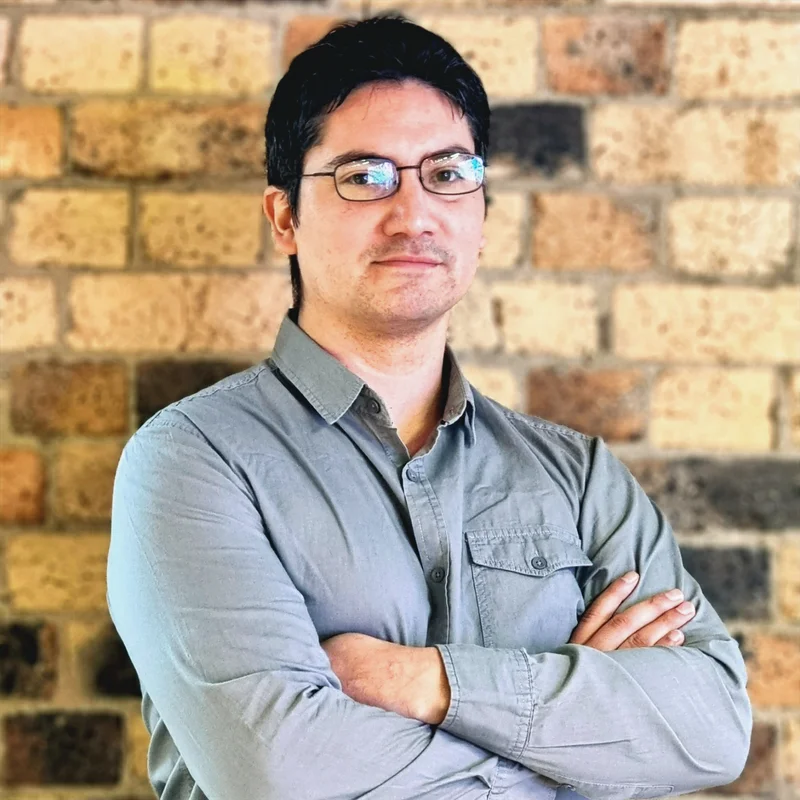
Aland Astudillo
AI and data consultant, background in biomedical engineering
Gold Coast, Queensland, Australia · English and Spanish
For fourteen years I have built data and AI systems for hospitals, public health agencies, governments, universities and companies. Imaging pipelines, retrieval and knowledge systems, forecasting and operational reporting, and the governance work that has to happen before any of it touches a real decision. The kind that have to keep working after the pilot ends.
Selected work
- Queensland Museum and the Queensland Government
At Clevvi Technology. Documenting First Nations cultural collections. I co-wrote the bid that won the Queensland Government's Private Sector Pathways challenge, securing $100,000 in funding, then designed and built the prototype over eight months: a gated multi pass AI pipeline that analyses several images of an artefact and drafts a provenance report in 3 to 8 minutes, with verifiable credentials for provenance through Anonyome Labs. Every record goes to curators and knowledge holders for review under ICIP governance. The system proposes, people decide. Demonstrated to more than twenty stakeholders across government, museums and industry. - A national agricultural research body
At Clevvi Technology. Version 2 of an econometric decision support platform. I took over the system with no original developers left, documented it end to end, proposed the v2 architecture, and built the serverless services that run the researchers' models, behind a feature flag with a fallback. - An Australian health technology startup
Through Sparkbrain. AI strategy and platform architecture, from the approach down to the shape of the system. - A Gold Coast community services organisation
Through Sparkbrain. Community data analytics and operational reporting, including the data model the reporting runs on. - Deep learning for mammography triage
Department of Biomedical Engineering, Universidad de Valparaíso, in a FONDEF funded pilot joining the university, the Chilean National Mammography Centre and an industry partner. I co-wrote the funding application, developed and validated the deep learning models that detect and prioritise findings in mammography, and built the image processing pipeline. It was a research pilot and was not taken into clinical use.
What I work on
I usually come in when the problem is still vague. I understand the problem with the people who own it, map the process, design a solution and choose the right tool for the organisation and team. Then the data science itself: machine learning and statistical modelling, AI and LLM applications, retrieval augmented generation and knowledge graphs, and the AI governance and risk work that lets an organisation put any of it in front of the public.
Mostly in health, government, research and industry, where the data is messy and the constraints are real.
Experience
- Founder and Principal Consultant, Sparkbrain 2024 to present
Independent AI, data and technology consultancy: digital transformation, process mapping, data modelling and AI applications. - Data Scientist | Senior AI and Digital Solutions Consultant, Clevvi Technology 2025 to August 2026
AI scoping and architecture for enterprise clients in regulated industries, document intelligence and RAG systems, and the governance frameworks that keep them auditable. - Senior Data Scientist, Research Graph Foundation; Data Scientist, Swinburne University of Technology 2024
Stakeholder engagement across partner organisations, co-design and data cooperative workshops, and hands on work with the underlying data of a national knowledge graph of the health and wellbeing research network, plus the project's final report. At Swinburne, knowledge graphs in Python and Neo4j, tool and method testing, and language model work for research ecosystem analysis. Mentored computational science interns. - Data Scientist, then Postdoctoral Research Fellow, NICM Health Research Institute, Western Sydney University 2023 to 2025, Adjunct Fellow since
High throughput pipelines for multi channel brain signal data, statistical generative models, and noise filtering for clinical datasets. - Machine Learning Engineer, Biomedical Engineering, Universidad de Valparaíso 2020 to 2022
Deep learning and medical image analysis, moving image processing pipelines into the cloud to prioritise high risk findings for review. - Data Analyst and Process Engineer, SEREMI de Salud, Valparaíso Region, Chile 2020
Public Health and Sanitary Planning Department. During the COVID-19 sanitary alert I built the data processing and the key indicators behind the region's testing, traceability and isolation strategy, supporting more than one hundred internal and external stakeholders and the Regional Epidemiology Unit. - R&D Manager and Innovation and Development Coordinator, then Clinical Engineer, Hospital Technology Centre (CTH), Chile 2012 to 2015
Built a hospital pre investment estimation tool that sized hospitals from the health network, population need, metrics and rates, producing bed, attention box and surgery room estimates. A manual study that took a team three months or more produced its first pass inputs in minutes. It produced the inputs to a sizing study rather than the study itself, and was a pilot demoed to the health ministry team, not taken further. Managed and coordinated maintenance contracts for medical and laboratory equipment at the Public Health Institute and the Servicio Médico Legal, and designed process and information management in hospitals and laboratories.
Tools
Document intelligence and RAG systems, knowledge graphs, agentic systems, clinical data pipelines, time series forecasting and medical image analysis.
- Technologies Python, R, SQL, MATLAB
- AI and LLM LangChain, FastAPI, Model Context Protocol, GraphRAG, prompt engineering, evaluation
- Machine learning PyTorch, TensorFlow, scikit-learn, pandas, NumPy, statistical and generative modelling, signal processing
- Data Neo4j, knowledge graph construction and entity extraction, PostgreSQL, MongoDB, vector databases
- Cloud and delivery AWS (EC2, S3, SageMaker, AgentCore), Azure, Docker, Git, CI/CD, web and mobile development
Collaborations
- Tedix — AI consultant
- Prende Tu Web — Australia coordinator and technology consultant
- Exonova Biotech — technology advisor
- Tellie — AI and data advisor
- Neboda Group — AI and data advisor
- NICM Health Research Institute, Western Sydney University — Adjunct Fellow
- Queensland University of Technology — Visiting Fellow, ARC Training Centre for Behavioural Insights for Technology Adoption, Faculty of Business and Law
What keeps my attention
Two lines of work. In industry, AI in settings where being wrong has a cost: health, government, anything with a regulator. The interesting problem there is rarely the model, it is the evaluation, the governance, and the handover to the people who have to live with it. In research, how brain activity organises itself over time, which is what my PhD was about and what I still publish on.
Applied AI writing
- Unveiling the synergy: retrieval augmented generation meets knowledge graphs — tools and platforms for integrating knowledge graphs with RAG pipelines
- The combined use of RAG and fine-tuning to improve LLM pipelines — when to retrieve, when to fine-tune, and when to do both
- What is LLMLingua? — prompt compression to improve large language model performance
- How to use GROBID to extract text from PDF files — machine-learning extraction of structured information from PDFs
Background
- BSc, MSc and PhD, Universidad de Valparaíso
Bachelor and Master in Biomedical Engineering, with a thesis on machine learning and statistical modelling in neuroscience, then a PhD in sciences, biophysics and computational biology, with a thesis on machine learning and statistical modelling applied to brain dynamics. - Certified Member , Australian Computer Society
- Registered expert , Scimex, Australian Science Media Centre
Research and writing
Peer-reviewed research in computational and cognitive neuroscience: statistical modelling of brain dynamics, signal processing and clustering, and computational models of neural activity, across both clinical and basic neuroscience. Further published work on retrieval augmented generation and knowledge graphs. Around twenty conference presentations across Australia, Chile, Canada and Italy. The full record is on Google Scholar and ORCID.
I have contributed to research programmes funded by NHMRC grants APP1195709 and APP1102532, and by FONDEF and FONDECYT grants in Chile.
- DeMente: el cerebro, un hueso duro de roer
“The brain, a tough nut to crack”
Popular science book on the brain, in Spanish. I wrote one chapter of it. Second edition, 2021, CINV. ISBN 9789563247213.
Profiles
Professional
Publications and research
Affiliations and expert registers
Contact
The quickest way to reach me is LinkedIn, or by email at aland.astudillo@sparkbrain.com.au.